Summary

  • Polls have closed in Thailand where millions have voted in a key election following years of political turmoil

  • The snap poll was called by Prime Minister Anutin Charnvirakul, the country's third leader in three years

  • Neither his Bhumjaithai Party nor the People's Party, which is leading in the polls, are expected to win a majority, making a coalition government likely

  • But the big question hanging over this election is how well the young, reformist People's Party performs, our South East Asia correspondent writes

  • If it exceeds the 151 seats it won in 2023, barring it from governing may prove difficult, despite the unease about its agenda in conservative and royalist circles

  • The economy, slowed down by a lack of reforms, high household debt and rising costs, is high on the agenda

  • Also on the ballot: a referendum on rewriting the military-backed constitution, which critics say gives too much power to the unelected senate

Media caption,
Will Thailand embrace sweeping change?
  1. A recap of a key election for Thailandpublished at 10:20 GMT 8 February

    Polls have closed and we're about to wind down this page. Before that, here's a recap of how the election is going so far and what happens next.

    • Results will start trickling in at 18:00 local time (10:00GMT), and a clear picture of how things stand could emerge around 22:00 local
    • This is an election for the 500-seat House of Representatives, the lower house of Thailand's parliament. Unlike in 2023, the unelected senate – the upper house dominated by conservatives – has no say in choosing the PM
    • This race is widely viewed as a battle between the conservative, military-backed Bhumjaithai Party led by current PM Anutin Charnvirakul and the reformist, opposition People's Party led by Natthaphong Ruengpanyawut. Anutin said he hopes voters will continue to trust his party, while Natthaphong has pledged policies that "benefit all, not just for the few"
    • And then there's Pheu Thai, backed by former PM Thaksin Shinawatra's family dynasty. The once-dominant party, which saw two PMs removed in the last two years, is hoping for a comeback with the latest Shinawatra member – Thaksin's nephew Yodchanan Wongsawat
    • Opinion polls show none of the parties will secure an overall majority, which makes a coalition government likely
    • Also on the ballot today is a referendum on rewriting a military-drafted constitution, which critics say give too much power to the senate

    Thank you for following our coverage of the election. You can read more in our news story here.

  2. Polls have closedpublished at 10:01 GMT 8 February

    Jonathan Head
    BBC South East Asia Correspondent

    Polls have closed in Thailand’s general election [1000 GMT], with no party likely to win an overall majority of the 500 seats in parliament, but a close race for first place between the reformist People’s Party and the conservative Bhumjaithai party of prime minister Anutin Chanrvirakul.

    Three years ago a previous incarnation of the reformist party won the election, but was barred from office and later dissolved.

    Thai voters were presented with a simple choice in this election; sweeping change, or more of the same. The two front-runners are ideological opposites.

    Prime Minister Anutin Charnvirakul, a wealthy construction tycoon, is now the standard-bearer for conservative Thais. Deeply loyal to the king, he has also struck a belligerently nationalistic tone in the wake of the border wars with Cambodia last year.

    Most polls though have put the rival People’s Party in first place, its radical agenda and young, passionate candidates winning over the growing number of Thais who believe their country is in need of root-and-branch reform.

    Voters were also asked to choose whether to change the military-drafted constitution, in a simultaneous referendum.

    However, winning an election is never enough in Thailand. The staunchly conservative constitutional court has sacked five prime ministers, dissolved dozens of parties and banned their leaders from politics whenever they appeared to challenge the status quo; everyone here knows the same could happen again.

  3. Preparations underway at the People's Party HQ in Bangkokpublished at 09:49 GMT 8 February

    Panisa Aemocha & Wasawat Lukharang
    BBC Thai, People’s Party HQ, Bangkok

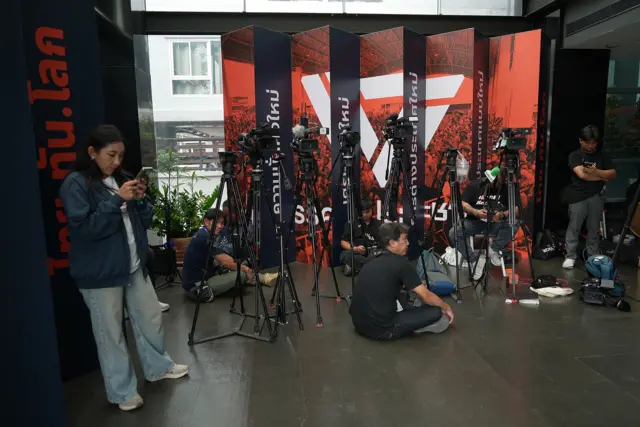
    The People’s Party headquarters in the capital Bangkok is ready to receive crowds of supporters.

    Apart from local and international media who have camped here since early afternoon, party supporters are beginning to arrive, wearing orange - the party's colour.

    The parking lot in front of the headquarters has been converted into a seating area, with plastic chairs set out for the crowd expected to arrive in full force after the ballots close at 17:00 local (10:00 GMT).

    Empty chairs arranged neatly at the People's Party headquarters in BangkokImage source, Wasawat Lukharang/BBC Thai

    The party's leading PM candidate Natthaphong Ruengpanyawut, arrived earlier with several senior party leaders to closely monitor the counting process.

    The party believes it is on track to secure the maximum number of seats in today’s elections.

    Veerayooth Kanchoochat, another of the party's prime ministerial candidates, told the BBC that the executives are now preparing for strategic discussions.

    A small gaggle of reporters get into position at the People's Party headquarters in BangkokImage source, Wasawat Lukharang/BBC Thai

    The party campaigned under the name Move Forward in 2023 and won the election but was blocked from forming a government by the unelected senate and the constitutional court, which ruled that its proposals to reduce harsh punishments under the lese majeste law amounted to an attempt to overthrow the entire political system. It was then dissolved and its leaders banned from politics.

    Asked if the party is concerned this could happen again, Veerayooth says, “This time there is a major difference, the senate no longer has the authority to vote for the prime minister.”

    “If we win the election, we will try to form a coalition as soon as possible," he says.

  4. Candidates get creative with wigs and fake moustachespublished at 09:36 GMT 8 February

    Paweena Ninbut
    BBC Thai in Bangkok

    Natthapong Ruengpanyawut with an orange wig in a People's Party campaign clipImage source, People's Party

    Earlier we wrote about how some activists are using cute cat memes to rally voters.

    Some candidates have also gotten creative in their campaigns, using wigs, fake moustaches and outrageous costumes in their short videos.

    A People's Party reel shows PM candidate Natthapong Ruengpanyawut in a fiery orange wig in a conversation with party colleague Suttasitt Pottasak, dressed up like an old man with curly grey hair and a thick moustache.

    Suttasitt initially says he plans to vote for different parties in his two ballots – one for a candidate in his constituency and another for a political party.

    “Uncle, if you want an Orange government, you have to vote for the constituency MP candidate from the Orange Party!” Natthapong advises the "uncle". "Orange party" here refers to the People's Party.

    “All right, all right! I get it now… how annoying, this young boy!” the uncle replies. The clip, posted last week, has been viewed by more than 3 million people.

    With low budgets, minimal editing, and awkward acting, the videos are oddly addictive and often hilarious.

  5. 'Nine millionaires a day': Bold vision or pipe dream?published at 09:06 GMT 8 February

    One of the Pheu Thai party's pledges is to create "nine millionaires a day".

    By consolidating transaction data, the plan aims to improve price monitoring and targeted aid for sectors in Thailand's vast informal economy, which include farmers and other small vendors, among others.

    As part of this plan, the party wants to award nine daily prizes of 1m baht ($31,700) each through draws.

    Pheu Thai's PM candidate Yodchanan Wongsawat says the scheme will add more than 3,000 millionaires to the country each year, or about 26,000 over eight years if his party remains in office for two terms, according to the Bangkok Post.

    While some supporters see this as a bold economic vision, opposition politicians have dismissed it as a "pipe dream", the Post reported. The Election Commission has also raised legal concerns about this promise.

    As a reminder, Pheu Thai is the latest incarnation of political parties backed by former Thai prime minister Thaksin Shinawatra.

  6. Growing concern around military-drafted constitution, says expertpublished at 08:51 GMT 8 February

    Paweena Ninbut
    BBC Thai

    As we reported earlier, Thailand is also voting for a referendum to replace the military-drafted constitution, which critics say gives too much power to the unelected senate.

    "Many Thai voters associate the current problems in society with the constitution," says Napon Jatusripitak, a political scientist at the ISEAS-Yusof Ishak Institute in Singapore.

    "We have had many prime ministers come and go as a result of constitutional court rulings on ethics," he says. The court has sacked two PMs in the last three years.

    The court operates "in tandem with" other public institutions when they are supposed to be independent, like the election commission and anti-corruption commission. "I think that is the main point of concern for people who are inclined to vote 'yes' [in the referendum]," Napon says.

  7. Could Thailand's Democrat Party make an impact?published at 08:35 GMT 8 February

    Abhisit Vejjajiva, a prime ministerial candidate of the Democrat partyImage source, Getty Images

    Founded in 1946, the Democrat Party is Thailand's oldest active political party.

    The party is not by any measure a frontrunner in this election - but as the country's fourth largest party, there is a possibility that it could play a role in any possible coalition that forms.

    The party's current leader, Abhisit Vejjajiva - who served as PM from 2008 to 2011 - has pledged to restore clean politics in the country and is aiming for 5% economic growth within the next four years

    The party currently holds 25 out of 500 seats in the House of Representatives.

  8. Key pledges largely overlook migrant workerspublished at 08:16 GMT 8 February

    Zeyar Htun
    BBC Burmese, reporting from Bangkok

    Migrants arriving in Mae Sot, a city in western Thailand that shares a border with MyanmarImage source, Getty Images
    Image caption,

    Migrants arriving in Mae Sot, a city in western Thailand that shares a border with Myanmar

    Migrant workers in Thailand contribute at least 4% - 6% of the country’s economic growth, and their share has been gradually increasing in recent years.

    Millions of people in Thailand's workforce are low-wage workers from Cambodia, Laos, Myanmar, and Vietnam, who have remained trapped in systemic loopholes because of frequent changes in Thailand's labour policies and leadership.

    But in their campaigns, most of the major parties spoke little about this sector of the workforce, migrant activist groups say, except for the Democrat Party, and the Movement Party, chaired by former MP Kannavee Suebsang.

    He adds that an incoming government that is more proactive in improving migrant welfare would be able to demonstrate to the international community that Thailand is no longer trying to sweep the problem under the carpet.

  9. For Thailand's progressives, winning the vote is only the first hurdlepublished at 07:56 GMT 8 February

    Jonathan Head
    BBC South East Asia Correspondent

    In Thailand, winning an election is never enough.

    The last one, less than three years ago, produced a surprise win for the progressive Move Forward party, which had campaigned on promises of root-and-branch political and economic reforms.

    These included making Thailand's powerful military, and its largest businesses, more accountable, and reducing the heavy punishments under the notorious lese majeste law.

    But powerful conservative forces, in particular the unelected senate and the constitutional court, blocked Move Forward from forming a government, dissolved the party and banned its leaders from politics. The court ruled that its proposals for the lese majeste law amounted to an attempt to overthrow the entire political system.

    Now, after three tumultuous years of short-lived coalition administrations, the sacking of two prime ministers by the constitutional court and a border war with Cambodia, the reformists are making another bid for power, this time under a new name - the People's Party.

    The biggest question hanging over this election is how well the People’s Party performs. If it exceeds the 151 seats it won in 2023, it may prove difficult to bar it from forming a government, despite great unease about its radical agenda in conservative and royalist circles.

    You can read more here.

  10. Unofficial results expected to come out before 23:00published at 07:41 GMT 8 February

    Unofficial results of the election could be out as early as 22:00 local time, according to Thai media reports citing the Election Commission Office.

    Polls close in less than three hours, and the results would start being reported from 18:00.

    Most counts should be completed by around 22:00 or 23:00, and the overall picture should be clear, says the office's secretary-general Sawaeng Boonmee.

  11. 'We've done everything we could', says PM Anutinpublished at 07:29 GMT 8 February

    Thailand's Prime Minister and Bhumjaithai Party leader Anutin Charnvirakul casts his ballotImage source, Getty Images

    Prime Minister Anutin Charnvirakul has cast his vote - adding that he hopes voters will trust his Bhumjaithai party.

    "We've done everything we could, but we can't force the hearts of the public," he told reporters, according to an AFP report.

    The ruling Bhumjaithai party ranked second to the reformist People's Party in several opinion polls ahead of today's vote, but Anutin could retain his position, depending on how coalition negotiations go.

    As most people do not expect a single party to secure a majority of seats in the house, Thailand's next government is likely to be a partnership between two parties.

  12. What to know about the Bhumjaithai partypublished at 07:13 GMT 8 February

    Anutin Charnvirakul in a white shirt and navy vest walking around, surrounded by a few people dressed similarlyImage source, Getty Images
    Image caption,

    Anutin Charnvirakul (second left) leads the Bhumjaithai Party

    • Led by Prime Minister Anutin Charnvirakul, the party has long been a power broker in Thai politics
    • Bhumjaithai - which literally translates to "Proud to be Thai" - is famously unideological and transactional, and in the past has been allied with conservative, military-backed groups
    • After the 2023 election it won 71 seats in the House of Representatives and formed a coalition with Pheu Thai Party, but left the alliance last year amid a scandal involving the then Prime Minister Paetongtarn Shinawatra, who was later removed from office
    • As a result, Anutin assumed the role - but under the condition that he had to call an election within four months and had to start the process of amending the country's constitution

  13. What to know about the Pheu Thai partypublished at 07:03 GMT 8 February

    Paetongtarn and her father ThaksinImage source, Getty Images
    • The populist Pheu Thai party represents the latest incarnation of political parties backed by former Thai prime minister Thaksin Shinawatra
    • The Shinawatras have dominated Thai politics for decades. The previous government coalition was led by Thaksin's daughter, Paetongtarn, together with Anutin's Bhumjaithai party
    • But Paetongtarn was removed from office last year after a leaked phone call scandal - and the Bhumjaithai party broke from the coalition, with Anutin securing enough support to win the premiership
    • The party is now hoping to make a comeback with its latest Shinawatra member - Yodchanan Wongsawat, Thaksin's nephew - at the helm
  14. What to know about the People's Partypublished at 06:48 GMT 8 February

    People's Party candidates smiling at supporters as they walk among a crowdImage source, Getty Images
    • They are the third incarnation of Thailand's progressive movement, which has championed better social and economic equality for Thais
    • Its predecessors, the Future Forward Party and Move Forward Party had sought to curb military and monarchy influence in politics
    • Their campaigns proved immensely popular, and in the last election, Move Forward emerged as the biggest winner. But it did not have an outright majority and was blocked from forming a government
    • Move Forward was dissolved in 2024 by Thailand's Constitutional Court, which ruled that it had violated the constitution by campaigning to amend the lese-majeste law
    • Despite being banned from politics, the leaders of Future Forward and Move Forward have helped to campaign in this election
    • But unless they get an outright majority and can govern on their own, the People's Party's path to power will likely be paved with hurdles
  15. Undergrad votes for equal education opportunities for allpublished at 06:27 GMT 8 February

    Thanyarat Doksone
    Producer, BBC News Bangkok

    Thanisorn Sitthisomboon

    First-time voter Thanisorn Sitthisomboon, who is studying to to be a teacher, says she hopes Thai children can have access to more education opportunities.

    "Thai kids should be able to get free education and students in the rural areas should have a chance to access good education also," the 21-year-old says.

    "I hope my vote today can somehow make that happen... I want it to be useful to the society and improve the country," she says.

  16. How Thailand became the 'sick man of Asia'published at 06:06 GMT 8 February

    Suranjana Tewari
    Asia Business Correspondent

    In the late 1980s, Thailand was hailed as an "Asian tiger", posting double-digit growth and seen as one of the region’s rising stars.

    Today, that shine has faded. Over the past five years, domestic consumption, manufacturing and even tourism - a pillar of growth - have all weakened.

    As a result, Southeast Asia’s second-largest economy has been expanding at a sluggish pace of around 2%, well behind regional peers like Vietnam and Indonesia.

    The International Monetary Fund predicts that growth will slow further this year to just 1.6%, the weakest among the region’s major economies.

    Structural problems are further weighing on the economy. Thailand has a rapidly ageing and shrinking population and one of Asia’s highest household debt levels.

    At the same time, an influx of cheaper Chinese goods and fierce competition from newer manufacturing hubs like Vietnam are eroding Thailand’s industrial base.

    Persistent political instability and frequent changes of leadership have only added to investor uncertainty, delaying reforms, weighing on infrastructure and tourism projects, and hitting overall confidence in the economy.

  17. Activist groups campaign with cat memespublished at 05:39 GMT 8 February

    Wasinee Pabuprapap
    BBC Thai

    Cat meme displayed on a mobile phone in relation to the referendum

    Besides electing their new government, Thailand is also voting today on a referendum on replacing its military-backed constitution.

    An activist group campaigning for Yes votes have been flooding social media with something quite unexpected - cat memes

    There are three versions of these AI-enhanced furry creatures: A crying cat holding a pen, a grumpy orange one with a ballot paper, and a tabby cat giving a thumbs-up. "On February 8, vote Yes", says the text on the picture in bright green colours.

    "We wanted to create a design that's fun, cool, and communicates in an easily accessible way that people can understand right away," a member of the group told BBC Thai.

    Media scholar Ethan Zuckerman coined the “cute cat theory of digital activism” in 2008, suggesting that activists are more immune to reprisals from authorities if they were using popular public platforms or memes because taking down these memes would provoke a larger public outrcry and encourage the activists' cause.

  18. Ex-PM Paetongtarn Shinawatra casts votepublished at 05:18 GMT 8 February

    Former PM Paetongtarn Shinawatra has also cast her vote. Thailand's Constitutional Court stripped her of her premiership in August last year, over a leaked call between her and Cambodian strongman Hun Sen. She held the post for just over a year.

    Paetongtarn Shinawatra
    Paetongtarn and the Shinawatra family outside a polling station
    Image caption,

    Paetongtarn and some members of the Shinawatra family outside a polling station

  19. What challenges will Thailand's new government face?published at 05:02 GMT 8 February

    Jiraporn Sricham
    BBC Thai

    From a sluggish economy to a liberal world order that is falling apart - the country's incoming government will face a series of different challenges.

    Ensuring sustainable GDP growth must be one of its key priorities, says economist Juthathip Jongwanich from the Thammasat University.

    South East Asia's second-largest economy has been expanding at a sluggish pace of around 2%, well behind regional peers like Vietnam and Indonesia.

    Rising public debt and the influx of "grey capital" – illicit or quasi-legal funds often originating from transnational criminal networks – are also issues to be addressed, Juthathip says.

    The new government must also contend with a new liberal world order.

    As the US focuses on "America First", the world lacks a counterbalance to China's power in the region, says political scientist Teewin Suputtikun from Chulalongkorn University.

    "The incoming government has to decide how Thailand can be part of a mechanism to prevent war and protect its interests."

  20. What happens after the election?published at 04:40 GMT 8 February

    Pita slumped in his chair, surrounded by men in suits.Image source, Getty Images
    Image caption,

    In 2023, Move Forward leader Pita Limjaroenrat's bid for prime minister was thwarted by lawmakers from other parties

    The polls show none of the parties are likely to get an overall majority of the 500 seats in parliament - meaning they will likely have to cobble together a coalition.

    Despite its popularity, the odds are stacked against the People's Party.

    In 2023, its predecessor, the Move Forward Party, was blocked from forming the government despite being the biggest election winner. The party's support for amending the country's controversial royal insult law had put it at odds with powerful conservative forces in parliament.

    But unlike in 2023, this time the Senate is not allowed to take part in choosing the next government.

    Yet everyone in Thailand expects some kind of move to block the People's Party once again. A case has been filed against 44 of its leading figures - including 15 of their parliamentary candidates - with the National Anti-Corruption Commission, over their personal endorsement of the lese majeste proposals.

    That could be used to bar them all from politics.