All about birthdays
Cakes, balloons, candles and gifts - these are just some of the things associated with birthdays. But for some countries, marking the special day of a loved one comes with its own unique traditions and rituals.
But why do we celebrate birthdays? What traditions are popular elsewhere around the globe? And which birthdays are the rarest?
Here, BBC Bitesize delves into the history of birthdays, some of the ways birthdays are celebrated across the world and which dates in the calendar are most and least popular to be born on.

Why do we celebrate birthdays?
A birthday is the anniversary of the date a person is born, which is celebrated annually. Although, if you're born on a leap year, you usually pick a date either side to mark the day!
In several religions, the births of founders and famous figures are also celebrated, often with special holidays. Birthdays can also be celebrated for the likes of businesses, companies and institutions, to mark the anniversary of their opening or founding.
It may seem obvious, but birthdays are celebrated to honour the lives of people we care about - marking the passage of time and celebrating all they have achieved. Several sources claim that early records of birthday celebrations date back to Ancient Egypt, Ancient Greece, Ancient Rome and more.
Which birthday traditions are most popular?
There are too many birthday traditions to name worldwide - and obviously individuals and their loved ones have unique traditions of their own. But there are a few traditions that are synonymous with birthday celebrations.
Let's start big with birthday cakes. It's not unusual to see some sort of cake - no matter what size, style, or flavour - during a birthday, decorated with candles. It's tradition in many places for guests to sing 'Happy Birthday to you' (another tradition in itself) as the birthday person blows out their candles and makes a silent wish.
Parties and decorations are also a big part of birthday celebrations. Whether it's a huge party or a small get-together, you can often expect everything from balloons and streamers to banners and even guests wearing party hats. Today, it's also popular for the birthday person to wear a badge, hat, sash or even a crown to mark the occasion.
Like many other annual holidays, birthdays often entail some sort of card, gift or small gesture. It doesn't have to be anything over the top, but a lot of people give birthday cards and gifts in celebration of that someone special.

How are birthdays celebrated in Australia and New Zealand?
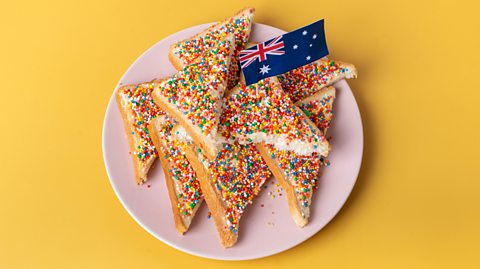
For many countries and cultures, indulging on sweet treats during a birthday celebration is nothing new. But when it comes to the special day, Australia and New Zealand have their own dessert. Fairy bread is a slice of white loaf which has been spread with butter or margarine and then covered in rainbow sprinkles. It is typically cut into triangles and is a popular feature at children’s parties.
While the recipe may seem simple, the origins of fairy bread aren’t entirely clear cut. An article in a Tasmanian newspaper from 1929 is argued to be the first report to mention fairy bread, listing the ingredients it is known for today. But its linguistic history spans back even further. Some scholars speculate that the term was coined from a 1885 poem of the same name by Robert Louis Stevenson in an anthology called A Child’s Garden of Verse.
Its closest relative is the Dutch breakfast snack hagelslag, which consists of bread covered in chocolate sprinkles. But good news for those with a sweet tooth is that hagelslag isn’t just reserved for birthday parties. It can be enjoyed anytime - result!
How are birthdays celebrated in China?
While a birthday cake in Chinese culture is optional, longevity noodles are a staple. In China, longevity noodles are served to the birthday person and, as the name suggests, symbolise long life. While the type of noodle used varies from region to region, it’s typically agreed the long noodle strands shouldn’t break or be bitten before they are eaten by the birthday person.
The noodle has been a popular food for at least 2,000 years and one of the earliest records of noodles in China appears in a book written during the East Han Dynasty between 25 and 220 A.D.
The longevity noodle is also central to celebrations in other East Asian countries such as Singapore and the Philippines. The dish is also a popular choice for the Lunar New Year, another celebration filled with food, rituals and symbolism.
In 2017, a food manufacturer in Henan, China, broke the world record for creating the longest noodle. The noodle measured 10,119ft (3,084m), took 17 hours to roll out and was eventually served to over 400 people.

How are birthdays celebrated in Mexico?
During a birthday celebration in Mexico, the tradition of la mordida, which translates to ‘the bite’, may take place. The ritual begins when the birthday person receives a cake, makes a wish and blows out the candles. A friend or family member will then push the birthday person's face into the cake as they take the first bite, while the guests cheer “Mordida!”.
The birthday person is often serenaded by friends and family with the song Las Mañanitas, meaning ‘little morning.’ This is usually sang early in the morning to wake the person up or before eating cake.
A piñata may also be involved in the birthday party, otherwise known as a fiesta. These colourful creations are usually made from papier-mâché and filled with sweets ready to be smashed to smithereens by both children and adults alike. The custom has been taken up by many other countries, including Spain and the United States.
While they are considered a significant part of Mexican culture, the origins of the piñata are still subject to historical debate. Some academics argue the tradition can be traced back to the Aztecs, who decorated and broke clay pots to celebrate the birth of the Aztec god, Huitzilopochtli. Others believe it has origins in China, a ritual that was later witnessed and spread across Europe by the 13th-century explorer Marco Polo.

What is my birthday sign?
If anyone asks you what your birthday sign is, it's likely they're referring to your star sign - meaning the signs of the zodiac.
In Western society, the zodiac is an imaginary belt in the sky that divides the Sun’s path into 12 sections, each associated with a corresponding constellation. The section of the zodiac the Sun occupied on the day you were born determines your star sign.
Each sign corresponds to a range of dates:
- Aries - 21 March - 19 April
- Taurus - 20 April - 20 May
- Gemini - 21 May - 21 June
- Cancer - 22 June - 22 July
- Leo - 23 July - 22 August
- Virgo - 23 August - 22 September
- Libra - 23 September - 23 October
- Scorpio - 24 October - 21 November
- Sagittarius - 22 November - 21 December
- Capricorn - 22 December - 19 January
- Aquarius - 20 January - 18 February
- Pisces - 19 February - 20 March
You might have also heard of birthstones - gemstones that represent a person's birth month. And did you know there are also birth flowers?
The idea is that each month of the year is linked with a seasonal flower that has a symbolic meaning. The tradition has its roots in Ancient Rome.

Is my birthday rare?
Through the years, you may have come across someone who has the same birthday as you - or know of other people who share a birthday.
But what was the most and least popular birthday in 2025? What is the most common birthday in recent years? And is your birthday rare?
According to the Office for National Statistics (ONS), the most popular birthday in England and Wales for 2025 was 28 May, with 1,844 live birthday recorded.
However, over a 30-year period, 26 September remains the most common average birthday. The ONS data covers the average number of live births from 1995 to 2025, and 26 September averaged at 1,927 births per year.
September 26 falls 39 weeks and two days after Christmas Day. Similar data from the ONS in 2015 suggested part of the reasons for the increase in births "could be due to couples planning to have children at the start of the school year."
As for the least common birthday in 2025, this was 26 December, Boxing Day, with 1052 live births recorded. This was one birth less than 25 December, Christmas Day, with 1053 births recorded.
Covering the average number of live births from 1995 to 2025, the least common birthday was again **26 December.**Over the 30-year period, Boxing Day was the least frequent standard calendar birth date with 1294 live births recorded.
Overall, 29 February is rarer and unique, as it only occurs once every four years during a leap year.
This article was published in September 2023 and updated in October 2026
