
Mars: New mosaic shows Mars as you've never seen it before
- Published

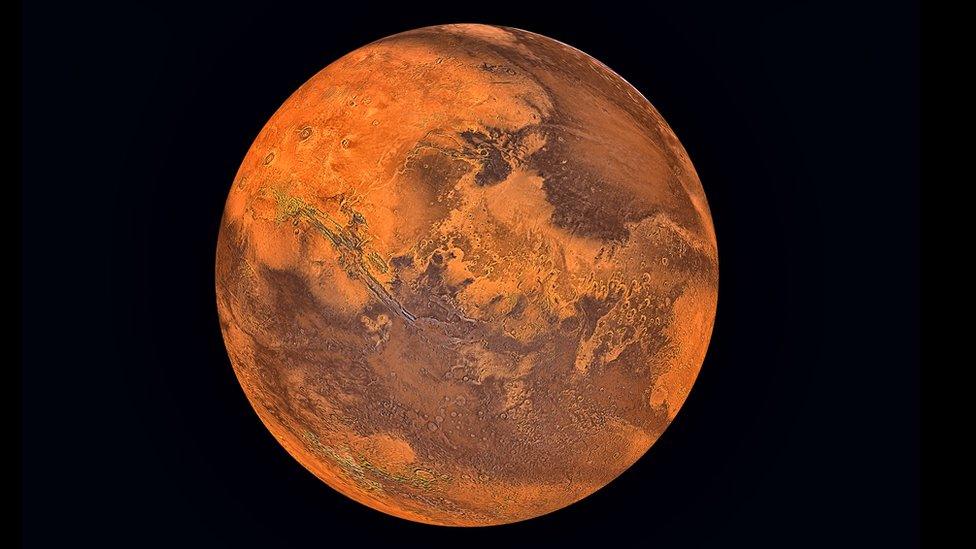
The image is not only nice to look at - scientists say it will give them lots of information about what Mars is really made of
You may have heard Mars being called 'the red planet', due to its reddish-brown surface.
But the European Space Agency have released a new image showing it's a bit more colourful than previously thought.
It's often difficult to get a good look at Mars using a camera - the atmosphere is very dusty, and this dust reflects light and makes the planet look a bit different to reality.
It's also got very changeable weather, which can be hard to see through.
But the ESA have used a very powerful camera called High Resolution Stereo Camera (HRSC) to take 90 super high-definition pictures of the plant's surface, which they've layered together in a mosaic.

Lots of different types of images were used to create the final mosaic - on the left you can see one image taken in visible light, and on the right one take in infrared
The colours are not only nice to look at, but they actually tell the scientists a lot about Mars and what it's made of.
The dark grey patches are sand dunes made of basalt sand, which comes from volcanic eruptions, and the bright blue is where water has eroded (or worn down) minerals such as clay and sulphate.
These areas are particularly exciting, as they indicate that water has existed on Mars for a very long time, as it takes a while for any amount of water to make dents in rock formations.

This picture taken by Nasa's Mars Rover shows a colour on the surface of Mars that you might be a bit more used to seeing
Iron oxide is what give Mars its rusty red colour
It's the second smallest planet in our solar system
It has a North and a South pole - just like Earth -which are covered in ice, and reaching temperatures as low as -140°C
A day on Mars is slightly longer than here at 25 hours, but a Mars year is almost twice as long as an Earth year, taking 687 days to orbit the sun
Mars has the highest mountain in the solar system, called Olympus Mons, which measures around 15 miles high - that's three times taller than Mount Everest!
The mosaic has been made to celebrate 20 years of the Mars Express, which is a spacecraft launched by ESA in 2003 to study the red planet.
Its HRSC camera on board is not only responsible for these images, but have also captured ancient lava pools, colossal volcanoes and impact craters made by meteorites.
The spacecraft's mission was initially planned to last for one Martian year, which is around 687 Earth days, but has been extended until at least the end of 2026.
If you cannot see the quiz, click here.
- Published1 June 2023

- Published26 July 2018
- Published27 November 2018


