Scientists predict Australia will suffer more and longer droughts
The Australian government's new emissions reduction target is about half of what is needed, and reinforces Australia's reputation as a climate change laggard, according to leading Australian scientists.
The government's argument that setting a stronger target would damage the economy is deeply flawed, they said in statements released through the Australian Science Media Centre on Tuesday.
Earlier in the day, Prime Minister Tony Abbott announced that the government planned to cut greenhouse gas emissions by between 26% and 28% below 2005 levels by 2030.
Australia's previous target was to cut emissions by 5% by 2020, based on emissions in 2000.
The pledge is less than cuts planned by countries such as Canada and the US but higher than countries such as Japan.
But in light of the huge risk posed by climate change, the government's new target is too weak, said Professor Steven Sherwood, co-director of the Climate Change Research Centre at the University of New South Wales.

Mr Abbott says jobs must be protected at the same time as emissions are cut
"Though it could have been worse, a 26% target is about half of what is really needed, and is weak enough to reinforce Australia's new reputation as the world's foot-dragger," said Prof Sherwood.
The world's leaders will meet in Paris later this year to agree on a new plan to curb global warming.
Australia has been criticised domestically and overseas for failing to do more to curb its greenhouse gas emissions.

Australia's climate change policies include:
Repealing a carbon pricing scheme - the "carbon tax" - introduced by the previous government
Adopting a "Direct Action" policy that funds businesses to take action to reduce or avoid emissions
Cutting a national renewable energy target that would have ensured 20% of power came from renewable sources by 2020
But the government has long argued that because of the country's heavy reliance on coal and gas for domestic energy and as an export, it cannot make deeper cuts.
Mr Abbott re-iterated that stance on Tuesday, telling journalists in Canberra it was important to protect jobs and the environment.

Hotter and drier weather brought about by climate change is fuelling bushfires in Australia
"This is not cost-free to the economy," Mr Abbot said of the 26% target, explaining that it would be a drag on the economy of between 0.2% and 0.3% of gross domestic product (GDP).
"The higher the target, the higher the cost," he said.
President of the Australian Academy of Science, Professor Andrew Holmes, says the new target is a step in the right direction.
"The science tells us that on a global scale we need to move towards zero carbon emissions by mid-century to avoid the most serious impacts of climate change," he said.
"So while some will argue that the Australian target could have been more ambitious, it does start us on the path towards this longer term goal."
But the Director of the Centre for Climate Economics and Policy at the Australian National University, Associate Professor Frank Jotzo, says the government's new target range falls short of the international community's goal of limiting the rise in global temperatures from pre-industrial levels to no more than to 2C.

Australian farmers will need to adapt to a harsher environment, say scientists
Beyond that, and the world will experience ever worsening floods, droughts, storms and rising seas, say climate change scientists.
"Most other developed countries' targets also fall short, but generally by less than Australia's," says Prof Jotzo.
"However this target means Australia is at least on the boat with international climate action, even if considered a laggard.
"Domestically it opens the door to stronger climate change action. A credible plan for domestic policy to achieve the target will be needed."
However, he notes that Australia's target for reduction in absolute emissions is significantly weaker than that of the US, Canada and the EU, while being on par with Japan's.

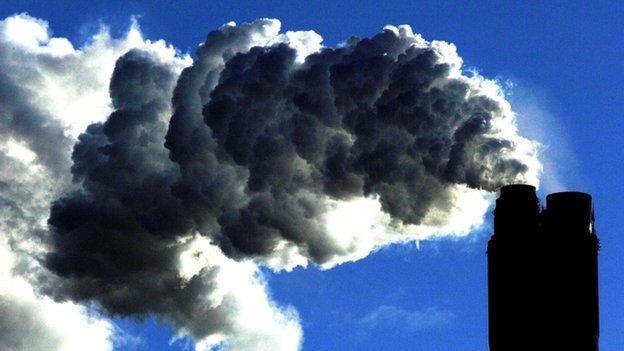
Australia remains heavily reliant on coal for domestic energy and exports
"The choice of 2005 [as its baseline year] makes Australia's target look better than under other base years," he says.
A baseline year is a reference point in time against which emissions reductions in the future are measured. Emission targets are very sensitive to the baseline year chosen.
The government's assumption that setting a stronger target will damage the Australian economy is deeply flawed, argue Adjunct Professor Alan Pears from Melbourne's RMIT University.
Prof Pears says expert groups such as the International Energy Agency point out that pursuing energy efficiency and energy innovation can save money rather than cost an economy.
"We can now see that trying to prop up our fossil fuel industries while global demand for them falls is a false economy that undermines our overall economic future," he says.
- Published10 June 2015
- Published3 August 2015

- Published23 July 2015